
This guide breaks it all down with a special focus on granite—how it forms, what affects granite countertop cost, and where it beats or loses to quartz.
If you’re choosing new countertops, you’ve probably found yourself asking:
Is quartz cheaper than granite… or is granite still the better value?
Then somewhere in the research you see the word shale and start wondering what on earth that has to do with countertops. (Spoiler: it doesn’t. Shale is a soft sedimentary rock, not something you want in a kitchen.)
The real decision for most homeowners is quartz vs granite countertops. Both are premium materials, both look fantastic, and both can boost resale value. But they behave very differently in terms of price, maintenance, and long-term performance.
This guide breaks it all down with a special focus on granite—how it forms, what affects granite countertop cost, and where it beats or loses to quartz.
Quick Answer: Is Quartz Cheaper Than Granite?
The honest answer is:
Sometimes quartz is cheaper, sometimes granite is cheaper — their price ranges overlap a lot.
From recent cost comparison data:
- Typical granite countertops average around $40–$100 per square foot installed, with common colors at the lower end and rare, exotic slabs going much higher.
- Quartz countertops often fall in a similar or slightly higher band — roughly $50–150+ per square foot installed, depending on brand, pattern, and edge details.
So:
- For basic to mid-range projects, granite is often a bit cheaper than quartz.
- For high-end designs, exotic granite can cost more than many quartz options.
- Long-term, quartz can save on maintenance (no sealing), while granite’s maintenance is low-cost but ongoing.
That means your specific quote may show quartz cheaper, granite cheaper, or almost identical — it depends heavily on color choice, slab quality, and local fabrication costs.
Now, let’s zoom in on granite and why it’s still a favorite even when quartz is competitive on cost.
Granite Geology and Composition: Why Granite Costs What It Does
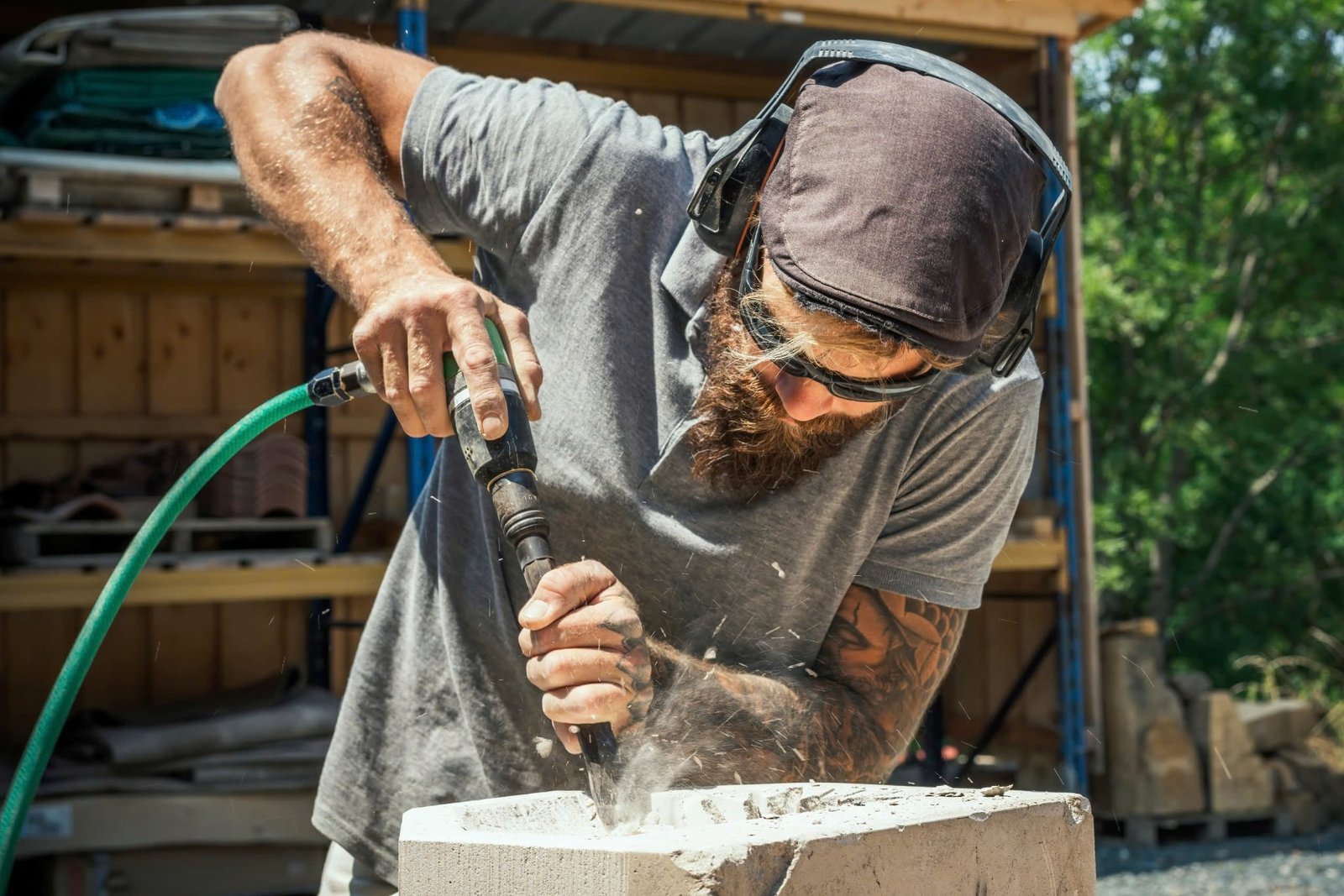
Granite isn’t just “a pretty rock.” It’s a natural igneous stone formed when magma cools slowly deep beneath the Earth’s surface. That slow cooling lets big crystals grow, giving granite stone its signature speckled look.
Granite geology and composition
Typical granite contains:
- Quartz – very hard, boosts scratch resistance
- Feldspar – often white, cream, or pink; sets the base color
- Mica & accessory minerals – dark flecks, veins, and sparkle
These minerals create the main characteristics of granite:
- High hardness and durability
- Excellent heat resistance
- Slight natural porosity (needs sealing)
- Ability to take a high, reflective polish
If you want to get nerdy about the deep-earth story, check out:
- What geologic process can change granite into gneiss?
- How can a large block of granite form layers like an onion?
- What Type of Weathering Is Illustrated by the Cracks in the Simulated Granite Outcrop?
Together, they show how granite responds to pressure, heat, and weathering long before it ever reaches your kitchen.
What Affects Granite Countertop Cost?
When you ask, “Is quartz cheaper than granite?”, what you’re really asking is, “What makes granite cost what it does?”
Key cost drivers for granite countertops:
- Color & rarity
- Common colors (simple blacks, whites, beiges)
= more affordable granite countertop options - Rare colors or dramatic veining
= premium slabs at a higher price
- Common colors (simple blacks, whites, beiges)
- Slab thickness & size
- Standard 2 cm or 3 cm thick
- Extra-thick or jumbo slabs cost more in both material and installation
- Edge profiles
- Straight or eased edges are cheaper
- Ogee, waterfall, or intricate edges add fabrication time and cost
- Project complexity
- Many seams, unusual shapes, or multiple cutouts (sinks, cooktops)
- Difficult site access or fragile cabinets needing reinforcement
- Finish type
- High-polish finishes are standard
- Honed or leathered finishes may cost extra depending on your fabricator
When you see a great deal on granite, it’s usually:
- A common, easy-to-source color
- In a straightforward layout
- From local or wholesale granite suppliers with good stock turnover
What Affects Quartz Countertop Cost?
Quartz is engineered, not natural — typically ~90–95% ground quartz plus resins and pigments. That manufacturing process affects price in different ways:
- Brand & design – Designer patterns that mimic rare marble or exotic stone cost more.
- Color consistency – Uniform, on-trend colors often come at a premium.
- Slab size & thickness – Similar to granite; thicker and larger = more expensive.
- Fabrication complexity – Edges, seams, and cutouts add cost just like with granite.
Many markets see entry-level quartz priced similar to or slightly above mid-range granite.
Granite vs Quartz Countertops: Cost + Value
Let’s compare them in practical terms, not just numbers.
1. Material & install cost
- Granite
- Often the cheaper option for common colors
- Can be more expensive than quartz at the high end
- Quartz
- Slightly higher starting point on average
- Very predictable pricing across colors and patterns
Overall, neither material is always cheaper — the overlap is significant.
2. Maintenance: sealing vs no sealing
- Granite
- Slightly porous
- Needs sealing granite every 1–2 years (fast and inexpensive)
- Proper sealing helps with removing stains from granite and keeping clean granite countertops easy
- Quartz
- Non-porous
- No sealing required
- Very stain resistant, but not invincible against heat damage
If you hate the idea of any maintenance, quartz wins. If occasional sealing doesn’t bother you, granite wins on natural beauty and resilience.
3. Durability & daily use
- Granite
- Excellent heat resistance
- Highly scratch-resistant
- Can chip on edges if struck hard, but repairing chips in granite is usually straightforward
- Quartz
- Very hard and impact-resistant
- Less tolerant of direct, high heat (e.g., hot pots straight from the stove)
In real kitchens, both are very durable when used and installed properly.
Granite Style & Design: Where It Still Shines
Even if quartz occasionally undercuts granite on price, granite still has unique design advantages.
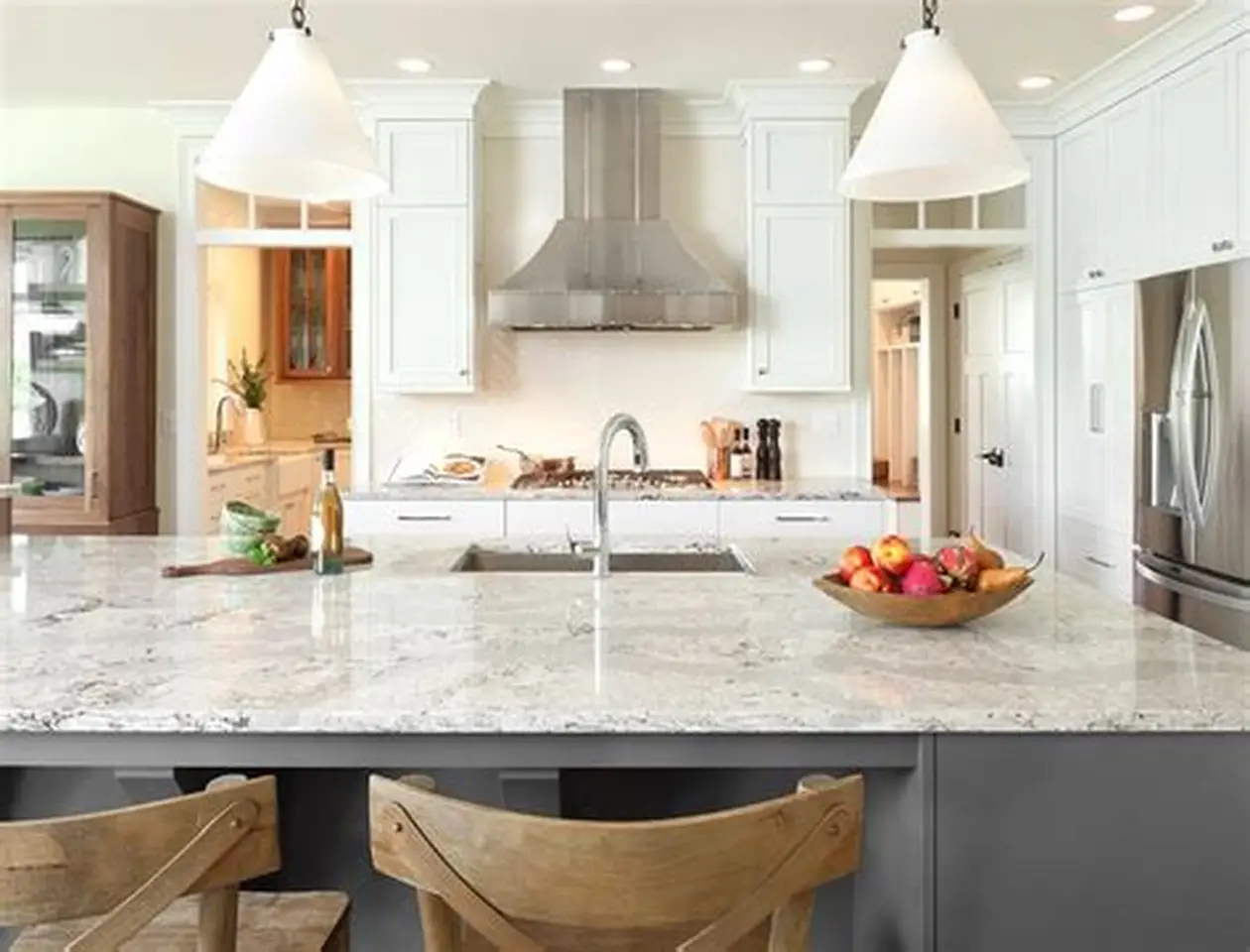
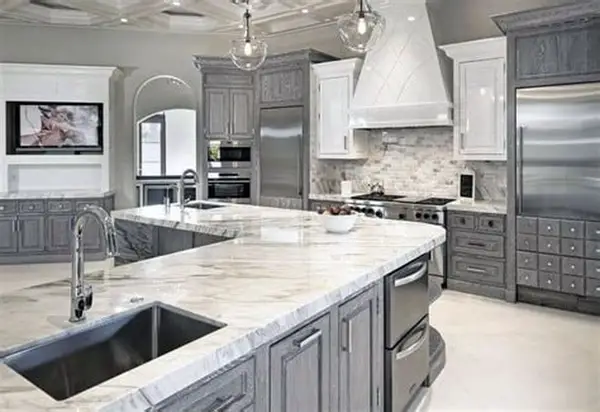
White and black granite countertops
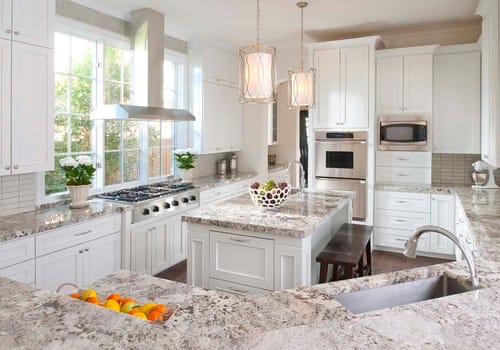
- A white granite countertop can brighten small or dark kitchens, pairing beautifully with light or wood cabinets.
- Black granite countertops create drama and contrast, especially in modern or monochrome designs.
Because each granite slab is unique, your kitchen truly becomes one-of-a-kind — something mass-produced quartz can only approximate.
Granite backsplash designs & cabinet pairing
To maximize the effect:
- Consider full-height granite backsplash designs for seamless luxury.
- Spend time pairing granite with cabinet colors so undertones and patterns complement, rather than clash.
Whether you choose subtle movement or bold veining, granite’s natural variation is a huge part of the appeal.
Natural vs. Engineered Granite: Long-Term Value
In a broader natural stone countertop comparison, granite also stacks up well against options like marble, soapstone, and concrete:
- Granite vs marble: pros and cons
- Marble is softer, prone to etching and staining.
- Granite is more forgiving and better for high-traffic kitchens.
- Granite vs soapstone durability
- Soapstone is very stain-resistant but scratches easily and often needs oiling.
- Granite resists scratches and keeps a polished finish with minimal upkeep.
- Granite better than concrete countertops?
- Concrete is very porous and crack-prone if not perfectly installed and sealed.
- Granite is naturally dense and strong, making it easier to own long-term.
Quartz competes closely with granite, but granite remains one of the best “all-rounders” when you weigh cost, durability, heat resistance, and natural beauty.
Granite Countertop Cost, Where to Buy & Aardwolf Solutions
If you decide granite is either cheaper or simply better value than quartz for your project, the next questions are:
- Where do I buy it?
- Which color or pattern do I choose?
- How do I keep costs reasonable?
Where to buy granite countertops
You can explore:
- Local fabricators and showrooms
- Wholesale granite suppliers (often the best selection of full slabs)
- Big-box retailers with affordable granite countertop options in standard colors
Aardwolf granite: curated quality and clear pricing
To simplify the process, the Aardwolf granite countertop collection brings together:
- Carefully selected Aardwolf premium granite slabs
- A versatile range of tones — from light, airy stones to deep, dramatic patterns
- Many of the best Aardwolf granite colors for pairing with popular cabinet and flooring styles
With Aardwolf granite installation services, you also get:
- Professional templating, cutting, and seam planning
- Correct supports for heavy stone
- Proper sealing and finishing so your granite is protected from day one
And the Aardwolf granite pricing guide helps you understand:
- Entry-level vs premium price bands
- How edge choices and layout complexity affect your quote
- Where granite can be more affordable than quartz in your specific design
So… Is Quartz Cheaper Than Granite?
In practice:
- Quartz is not automatically cheaper than granite.
- For many standard kitchens, granite is still slightly cheaper on average, especially in common colors.
- At the high end, either material can cost more, depending on what you choose.
So instead of asking only “Is quartz cheaper than granite?”, a better question is:
“Which material gives me the best balance of price, performance, and style for my project?”